
Deliverability Guide
What Are Email Warmup Tools and How Do They Work?
You've created a new email address. Your prospect list is ready. But sending hundreds of emails immediately could damage your sender reputation. Here's how warmup tools help.
Introduction
You've created a new email address.
Your prospect list is ready, your campaign is written, and your sales team is ready to begin outreach. But sending hundreds of emails immediately could damage your sender reputation before the campaign has a chance to perform.
Mailbox providers evaluate sending patterns, engagement, authentication, and reputation when deciding where an email belongs. A sudden increase in activity from a new or inactive account can appear suspicious.
That's where email warmup tools come in.
An email warmup tool gradually increases sending activity and helps establish a consistent history before you scale outreach. Instead of managing the process manually, automated email warmup helps teams prepare multiple mailboxes while monitoring their performance.
Let's explore what email warming is, how email warmup software works, and how it connects to sender reputation and deliverability.
Why warmup matters
Mailbox providers trust consistent, gradual sending patterns. Sudden spikes trigger spam filters.
1. What Is Email Warmup?
Email warmup is the process of gradually increasing activity from a new, inactive, or low-volume email account.
The goal is to establish consistent sending behavior before scaling email outreach.
For example, if an email address has little sending history and suddenly sends hundreds of messages, the activity may appear unusual. Gradual warmup helps create a more consistent sending pattern.
Core objective
Build a positive sending history so providers recognize your domain as legitimate.
1.1 What Is Email Warming?
Email warming and email warmup refer to the same basic process.
A typical warmup process may include:
Typical warmup steps
Gradual volume increases build trust with mailbox providers.
- Starting with lower daily sending volumes
- Increasing activity gradually
- Generating natural email interactions
- Monitoring bounce rates
- Tracking spam placement
- Adjusting activity based on performance
The objective
The objective isn't simply to send more emails. It's to create stable sending behavior that supports long-term deliverability.
1.2 What Is Email Domain Warmup?
Email address warmup focuses on an individual mailbox. Email domain warmup focuses on establishing a healthy sending history for the domain.
This distinction matters because mailbox providers evaluate signals associated with both individual senders and domains.
For revenue teams operating multiple mailboxes, a strong warmup strategy should consider both levels.
2. What Are Email Warmup Tools?
Email warmup tools are software platforms designed to automate the email warming process.
Without automation, someone would need to send emails manually, generate conversations, monitor responses, and increase activity over time. This becomes difficult when an organization manages multiple domains and sender accounts.
An email warmup service automates much of this process.
Depending on the platform, email warmup software may help teams:

Common features
Automation turns a tedious manual task into a scalable process.
- Gradually increase sending activity
- Create consistent sending patterns
- Monitor mailbox performance
- Track deliverability changes
- Identify potential reputation issues
- Manage multiple email accounts
Platform scope
Some platforms focus exclusively on warmup, while others combine it with deliverability monitoring and outreach automation.
2.1 Manual vs Automated Email Warmup
Manual warmup may be manageable for one email address.
It becomes much harder to scale across dozens of mailboxes.
Automated email warmup reduces manual work by managing gradual activity increases and monitoring mailbox performance.
For revenue teams, the biggest advantage is consistency. Multiple mailboxes can follow structured processes without requiring sales representatives to manage every step manually.
Key difference
Manual works for 1 inbox. Automated works for 100.
2.2 What Is an Email Warmup API?
An email warmup API allows organizations to connect warmup functionality with existing sales or email infrastructure.
Businesses may use an API to add new mailboxes to warmup workflows, monitor progress, retrieve mailbox health information, or connect warmup data with internal reporting systems.
This can be particularly useful for organizations managing email infrastructure at scale.
API advantage
Integrate warmup directly into your existing sales stack for seamless operations.
3. How Do Email Warmup Tools Work?
Most email warmup tools follow a gradual process rather than immediately increasing sending volume.
Step-by-step process
A structured, incremental approach is the foundation of effective warmup.
- Connect the Email Account
- Start With Lower Activity
- Generate Engagement Signals
- Monitor and Adjust
Connect the Email Account
The first step is connecting the mailbox to the warmup platform. Once connected, the software can begin managing warmup activity and monitoring performance.
Start With Lower Activity
A new mailbox shouldn't immediately begin high-volume outreach. The warmup tool starts with lower sending activity and gradually increases volume over time. The rate of increase may depend on mailbox age, domain history, engagement, and performance.
Generate Engagement Signals
Sending volume is only one part of email performance. Mailbox providers may also consider how recipients interact with messages. Depending on the service, warmup tools may support email interactions intended to establish a history of normal sending activity.
Monitor and Adjust
Effective warmup shouldn't rely on a fixed schedule alone. Email warmup software may monitor bounce rates, delivery performance, spam placement, sending patterns, and reputation indicators. If performance declines, the warmup strategy may need to be adjusted rather than automatically increasing volume.
4. How Sender Reputation Affects Email Warmup
Email warmup and email sender reputation are closely connected.
Sender reputation represents how trustworthy your sending activity appears to mailbox providers. Stronger reputation can support better inbox placement, while poor reputation may increase filtering or rejection.
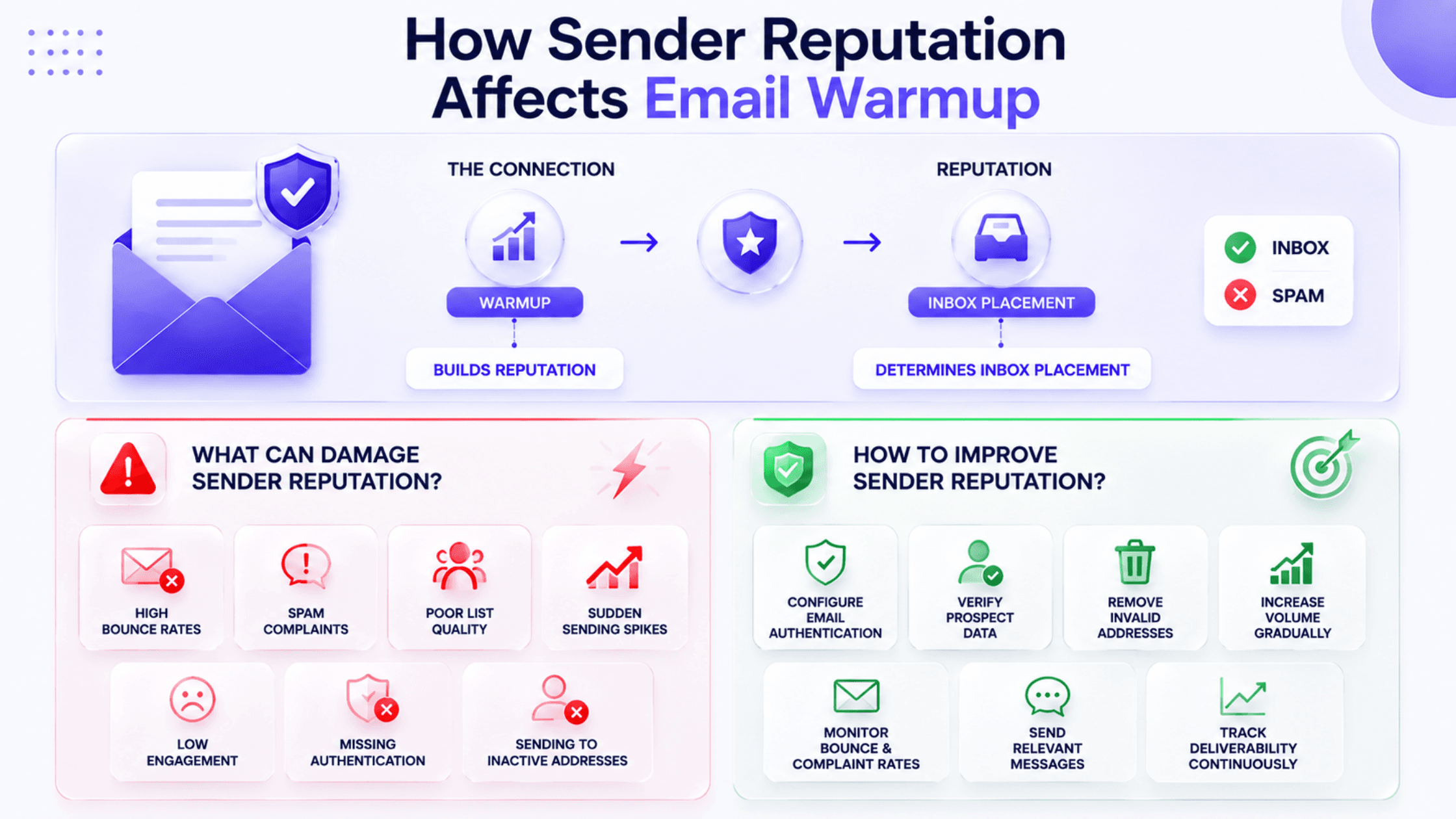
The connection
Warmup builds reputation. Reputation determines inbox placement.
Why reputation matters for warmup
A mailbox with a poor reputation will struggle to achieve good inbox placement regardless of how carefully it is warmed up. That is why warmup should be part of a larger strategy that includes authentication, list quality, and consistent sending practices.
4.1 What Can Damage Sender Reputation?
Several factors can negatively affect email sender reputation:
Common reputation killers
Avoid these to protect your sending infrastructure.
- High bounce rates
- Spam complaints
- Poor list quality
- Sudden sending spikes
- Low engagement
- Missing authentication
- Sending to inactive addresses
Remember
This is why warmup is only one part of a healthy deliverability strategy. A well-warmed mailbox can still lose reputation if outreach practices are poor.
4.2 How to Improve Email Sender Reputation
If you want to improve or fix email sender reputation, start with the fundamentals:
Action plan
Reputation is built over time with consistent good practices.
- Configure email authentication
- Verify prospect data
- Remove invalid addresses
- Increase volume gradually
- Monitor bounce and complaint rates
- Send relevant messages
- Track deliverability continuously
Long-term view
The relationship between email deliverability and sender reputation continues long after the initial warmup period.
5. How to Choose an Email Warmup Tool
Not every email warmup tool offers the same capabilities.
Some focus on basic warmup, while others combine warmup with deliverability analytics, reputation monitoring, and sales automation.
When comparing email warmup software, consider:
Selection criteria
The right platform should fit your scale and workflow.
- Automated warmup capabilities
- Multiple mailbox management
- Deliverability insights
- Sender reputation monitoring
- Analytics and reporting
- API availability
- Integration with existing workflows
Bottom line
The right platform should help you understand not only whether a mailbox is warming up, but whether the overall email infrastructure is healthy.
6. Free vs Paid Email Warmup Tools
Free email warmup tools may be useful for individuals testing a new mailbox or running limited outreach.
They can help teams understand the basic warmup process without committing to a larger platform.
However, growing revenue teams often need greater visibility.
Paid email warmup software may provide:
Paid advantages
Free tools are great for testing. Paid tools are built for scaling.
- Multiple mailbox management
- Advanced analytics
- Reputation monitoring
- Deliverability insights
- Workflow automation
Final thought
The best free email warmup tool isn't necessarily the best choice for a scaling sales organization. The right option depends on the number of mailboxes, campaign volume, and level of monitoring required.
7. Does Email Warmup Actually Work?
A structured warmup process can help establish consistent sending patterns for new or inactive mailboxes.
But email warmup isn't a shortcut to guaranteed inbox placement.
It works best when combined with:
Success factors
Warmup is most effective as part of a broader strategy.
- Proper authentication
- Clean prospect data
- Gradual volume increases
- Relevant outreach
- Low complaint rates
- Continuous monitoring
Warning
Warmup cannot compensate for poor lists or aggressive sending behavior. It should be treated as one part of a broader email deliverability strategy.
8. Best Practices for Email Warmup
Following best practices ensures your warmup efforts translate into long-term deliverability gains.
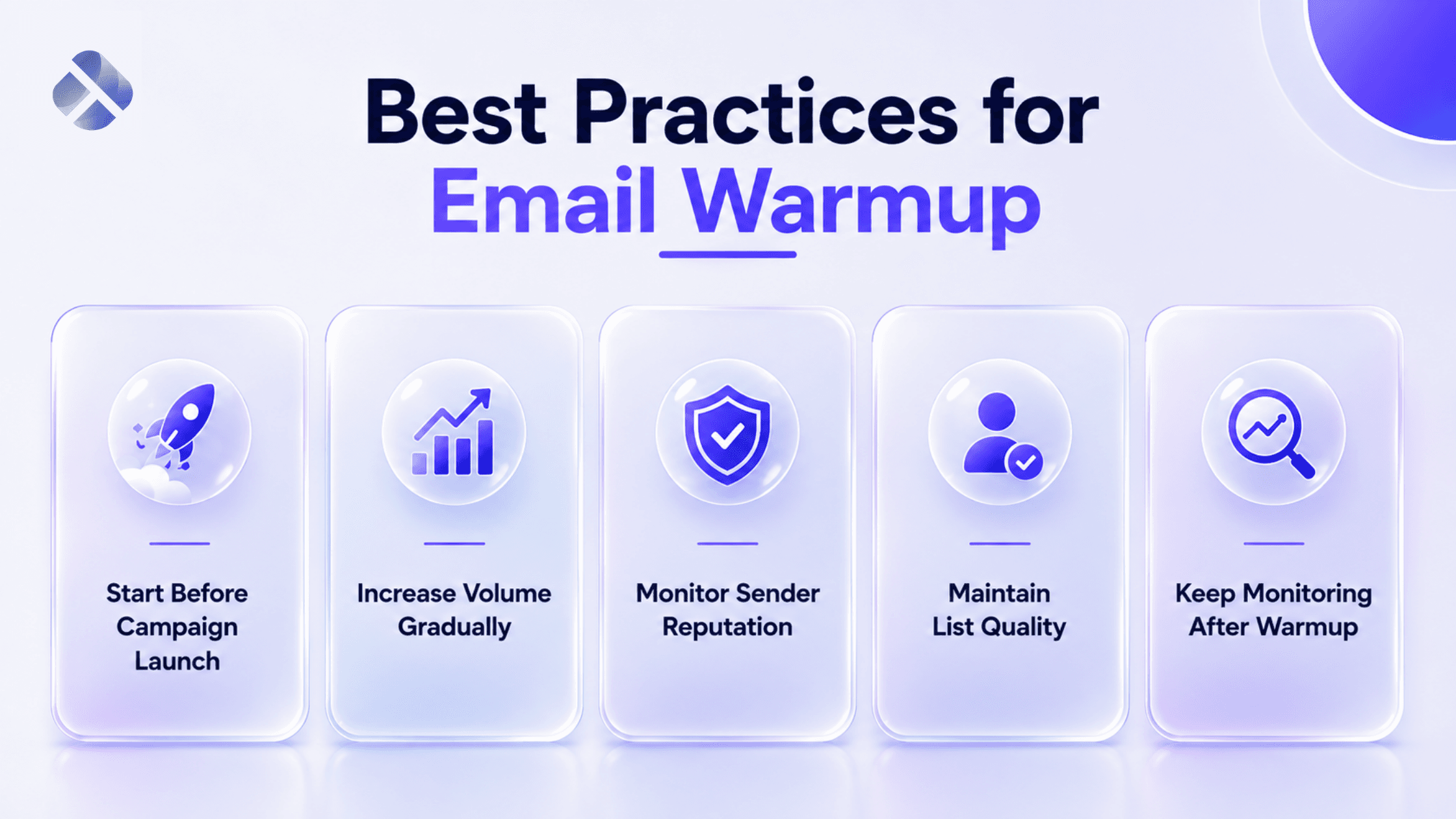
Core principles
Start slow, monitor everything, and never stop verifying.
8.1 Start Before Campaign Launch
Give new or inactive mailboxes time to establish consistent activity before scaling outreach.
8.2 Increase Volume Gradually
Avoid sudden spikes. Adjust sending volume based on mailbox performance rather than following the same schedule for every account.
8.3 Monitor Sender Reputation
Use an email sender reputation check alongside bounce, complaint, authentication, and inbox placement data. A single sender score doesn't provide the complete picture.
8.4 Maintain List Quality
Invalid email addresses can quickly damage a healthy reputation. Verify prospect information before launching campaigns.
8.5 Keep Monitoring After Warmup
Warmup isn't a one-time fix. Sender reputation can change as volume, engagement, and list quality change. Continuous monitoring is essential.
9. Frequently Asked Questions
Quick answers
Clarifying common questions about warmup.
An email warmup tool is software that automates gradual sending activity and helps monitor mailbox performance before higher-volume outreach begins.
Email warmup services help establish consistent sending activity for new or inactive email accounts through gradual volume increases and performance monitoring.
Email warmup can support consistent sending behavior, but it works best alongside authentication, clean data, responsible sending practices, and deliverability monitoring.
The best email warmer depends on your needs. Look for automated warmup, multiple mailbox management, deliverability visibility, reputation monitoring, and useful integrations.
Email warmup for Outlook involves gradually establishing consistent sending activity while monitoring performance across Microsoft's email ecosystem. Sender reputation, authentication, engagement, and list quality remain important.
High bounce rates, spam complaints, poor list quality, missing authentication, sudden volume increases, and consistently low engagement can negatively affect sender reputation.
10. Build a Stronger Foundation for Email Outreach
Successful email outreach starts before the first campaign is launched.
Email warmup tools help teams gradually prepare new or inactive mailboxes, establish consistent sending behavior, and reduce the manual effort involved in managing warmup.
But warmup is only one part of the equation.
Revenue teams also need visibility into sender reputation, authentication, deliverability, and inbox placement. When these elements work together, businesses can build healthier email infrastructure and scale outreach with greater confidence.
360Airo
360Airo brings email warmup, deliverability intelligence, and AI-powered outreach into a connected workflow, helping revenue teams protect sender reputation and improve campaign performance.
Final thought
Build a stronger foundation for outbound email with intelligent warmup, continuous monitoring, and AI-powered deliverability insights from 360Airo.
Recent blog posts
View all
Cold Email
10 Cheapest Cold Email Software Tools for Startups & Agencies
Discover affordable cold email tools for 2026.

AI Sales
How AI Prospecting Improves Sales Efficiency
Read this next to go deeper into modern sales workflows.

CRM Integration
CRM Integration Best Practices for Outreach Teams
Read this next to go deeper into modern sales workflows.